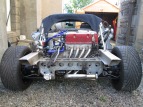
Car just failed emission test, Lambda reading over by 1 above max. I fitted a new CAT recently, when bought last year it had a bypass pipe fitted. I have had a look around and found the Lambda sensor had been disconnected and tied back. I have reconnected this and the car seems to run fine.
My questions are :-
why would someone disconnect the sensor?
What is the effect of disconnecting the sensor?
Is this likely to be the cause of the problem and how can I check that the sensor is OK, resistance/ voltage values?
MOT Fail - Emissions

Dunno why you would disconnect it, it would just screw up your emissions and fuel economy, probably the cat too.
its there to protect the cat, Robin is your man for how to test it. Probably nothing up with it.
its there to protect the cat, Robin is your man for how to test it. Probably nothing up with it.
1994 Lotus Esprit S4 - Work in progress
1980 Porsche 924 Turbo - Funky Interior Spec
2004 Smart Roadster Coupe - Hers
1980 Porsche 924 Turbo - Funky Interior Spec
2004 Smart Roadster Coupe - Hers
Re: MOT Fail - Emissions
car retested after getting properly warmed up and passed OK. I am still not sure if it was the lambda sensor being disconnected or just the car needing a good Run that caused the fail. hopefully the fuel consumption will be better now as well.
Exige S1, laser blue.(sold)
Honda Elise S1 Sport 135.(sold)
V8 Vantage
Honda Elise S1 Sport 135.(sold)
V8 Vantage

Re: MOT Fail - Emissions
The lambda sensor was probably gubbed which is why it got disconnected. On the other hand, you've passed the MOT so who caresSandy wrote:car retested after getting properly warmed up and passed OK. I am still not sure if it was the lambda sensor being disconnected or just the car needing a good Run that caused the fail. hopefully the fuel consumption will be better now as well.

Provided it idles OK and you don't get any bad smells out of the cat I think you're safe to worry about that later.
You can also test them ...
shameless cut'n'paste from seloc wrote: The Lambda Sensor, also known as an Oxygen or O2 sensor, gives a voltage feedback to the ECU indicating the amount of oxygen in the exhaust stream, thus allowing accurate control over the combustion mixture. This is important to minimise emissions, maximise fuel economy and ensure the longevity of the catalytic converter.
On a standard Elise exhaust, it is located on the manifold downpipe, somewhat resembling a spark plug in appearance, screwed into a threaded hole facing the front of the engine. It will (usually) have 4 silicone sheathed wires emerging from it, and may also have an outer heat resistant wrap covering the wires until they have run some distance from the exhaust.
The wires are usually colour coded as follows:
* White (x2) - heater wires. Voltage is supplied via these from the ECU to pre-heat the sensor to its operating temperature when the engine is warming up. Polarity is not important.
* Grey - sensor ground (earth)
* Black - sensor signal (+ve)
Correct Operation
A correctly operating sensor acts as a fuel cell once heated to a minimum of 300°C, producing a voltage by electromechanical means, which typically ranges from around 0.2 volts in the case of a lean mixture to 0.8 volts for a rich mixture. The optimum mixture ratio is reached at around 0.45 volts.
Sensor Testing
* Disconnect the sensor from the ECU at the square, black plastic connector, so that the sensor's voltage may be measured in isolation.
* Attach an electronic voltmeter or oscilloscope (adjusted to a 1.0 volt range) across the black and grey wires attached to the lambda sensor. This can be done in a number of ways; paring back the insulation from the wires, attaching sprung probes directly to the pins in the connector, pushing pins or IDC splicing blocks through the insulation on the wires, etc. DO NOT use a moving coil meter to test the sensor, as the meter's low internal resistance will almost certainly damage it.
* Start the engine and allow it to warm up for several minutes. As the heater wire has been disconnected from the ECU, it will take longer than normal for it to reach its 300°C minimum operating temperature.
* Examine the voltage output from the sensor. It should be greater than 0.2 volts. No voltage, or a very tiny voltage - far below 0.2 volts, most likely indicates a faulty sensor.
* Rev the engine and examine the change in voltage at the sensor. There should be practically no time delay between the engine being revved and a change in voltage at the sensor. A long delay may also indicate a faulty sensor.
I is in your loomz nibblin ur wirez
#bemoretut
#bemoretut
Re: MOT Fail - Emissions
Thanks for the info Robin. As you say it seems to be running OK for now, but I can check it out when I get a chance.
Exige S1, laser blue.(sold)
Honda Elise S1 Sport 135.(sold)
V8 Vantage
Honda Elise S1 Sport 135.(sold)
V8 Vantage
-
Matelotman
- Posts: 1564
- Joined: Mon Aug 13, 2007 2:37 am
- Location: West Lothian
Re: MOT Fail - Emissions
I had a Punto that stuttered and spluttered when the lambda was connected..... when it was disconnected it ran perfectly smooth. On a better note, my car was MOT'd today and the tester doesn't reckon that he's ever seen emissions so low 
Elise S1 B&C 140 - long time ago now