Ta Robin!
Pedal Power
So would the plan be an electric handbrake?
Surely there would be a delay as the pump built up pressure? A positive displacement pump would also be necessary too wouldn't it, as the fluid doesn't flow, you just need pressure.
1994 Lotus Esprit S4 - Work in progress
1980 Porsche 924 Turbo - Funky Interior Spec
2004 Smart Roadster Coupe - Hers
1980 Porsche 924 Turbo - Funky Interior Spec
2004 Smart Roadster Coupe - Hers
Electric motor drives pump which drains a reservoir and feeds hydraulic accumulator, plus shut off switch when pressure reaches max in the accumulator. Handbrake lever opens valve to allow pressure to be applied to rear brakes (probably via a master cylinder type of arrangement - i.e. you feed pressure into one side, the piston slides and pushes pressure into the other side). When you release it a valve allows pressure to vent back to reservoir (not sure how much actual fluid flow there would be - some I guess).RICHARDHUMBLE wrote:So would the plan be an electric handbrake?
Surely there would be a delay as the pump built up pressure? A positive displacement pump would also be necessary too wouldn't it, as the fluid doesn't flow, you just need pressure.
Cheers,
Robin
I is in your loomz nibblin ur wirez
#bemoretut
#bemoretut
I was thinking it must be accumulator driven to get the response down. Should only be enough flow to fill the caliper pistons, ie feck all.
To keep the weight and complexity down (Perhaps) the old Tonka (Torn-a-doo F3) had an undercarriage one shot blow down system which was a accumulator just charged with gas. when it was fired the hyds were pressurised with the gas and the undercarriage blown down. Could save the weight of a pump etc. Would only give a few shots before recharge but might be viable for Autotest. recharge from any inert compressed gas, CO2, nitrogen etc.
The idea is to have an accumulator part filled with brake fluid and closed off with a valve. The top of the accumulator is then charged up to the required pressure with Nitrogen (Or CO2) when required the bottle is fired (solenoid poppet valve?) and the hyds pressurise, locking the rears. Upon button release the pressure is vented back to reservoir as normal. (Another solenoid poppet valve?) This should give as many apps ass it takes for all the fluid in the accumulator to return to reservoir. Each shot would have slightly reduced pressure each time so must initially be higher than required.
?

To keep the weight and complexity down (Perhaps) the old Tonka (Torn-a-doo F3) had an undercarriage one shot blow down system which was a accumulator just charged with gas. when it was fired the hyds were pressurised with the gas and the undercarriage blown down. Could save the weight of a pump etc. Would only give a few shots before recharge but might be viable for Autotest. recharge from any inert compressed gas, CO2, nitrogen etc.
The idea is to have an accumulator part filled with brake fluid and closed off with a valve. The top of the accumulator is then charged up to the required pressure with Nitrogen (Or CO2) when required the bottle is fired (solenoid poppet valve?) and the hyds pressurise, locking the rears. Upon button release the pressure is vented back to reservoir as normal. (Another solenoid poppet valve?) This should give as many apps ass it takes for all the fluid in the accumulator to return to reservoir. Each shot would have slightly reduced pressure each time so must initially be higher than required.
?
1994 Lotus Esprit S4 - Work in progress
1980 Porsche 924 Turbo - Funky Interior Spec
2004 Smart Roadster Coupe - Hers
1980 Porsche 924 Turbo - Funky Interior Spec
2004 Smart Roadster Coupe - Hers
- thinfourth
- Posts: 3177
- Joined: Tue Mar 15, 2005 12:06 pm
- Location: Playing in the mud near aberdeen
- thinfourth
- Posts: 3177
- Joined: Tue Mar 15, 2005 12:06 pm
- Location: Playing in the mud near aberdeen
Well lets find a scrutineer and find outmac wrote:I'm not sure if it such an item would pass scruntineering. I don't think Paul's would but that could be down to positioning and "installation issues"
![]()
Mac
Or you could get some of those stupidly expensive dry break connection for brake lines and make it removable
http://www.goodridge.net/uk/pdf/motorsp ... bli_uk.pdf
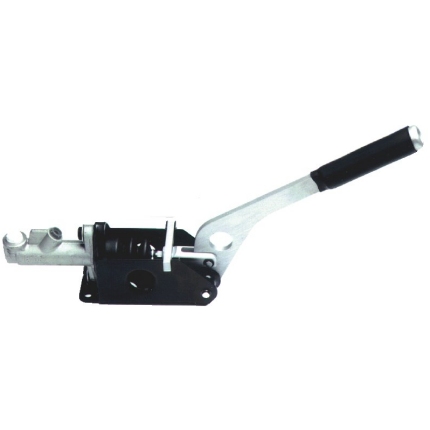
I want a happy handle for the catering van for when I do auto-tests. I'm concerned that a thinforth style installation (ie hydralic fluid in the cab) would fail scrutineering for sprints/hillclimbs and circuit racing.
Hence the though of an electro/mechanical device which could be removed as and when required.
Mac
Hence the though of an electro/mechanical device which could be removed as and when required.
Mac
- Novice Racer
- Posts: 367
- Joined: Mon Aug 07, 2006 2:18 pm
robin wrote: It's not really very hard ...
(1) Take a guess at force on brake pedal - say you can lift 200Kg weight with one leg (I haven't been to a gym since I was 16, so cannot say how many kgs a leg can lift - but I know I can just about lift me + one son on one leg, so 200Kg is high ballpark). That's 2000N, ish.
(2) Take a guess at the gearing from pedal to push rod into master cylinder - say 5:1 (i.e. the pedal is 5x further away from the pivot than the master cylinder rod is) - so that's 10,000N into the master cylinder.
(3) Take a guess at the cross sectional area of the master cylinder. Say 20mm diameter = 10mm radius -> pi*r^2 = 3.141 * 10 * 10 = 314 sq.mm.
(4) Take a guess at the cross sectional area of the pistons - now here you need some fudging depending on how many pistons you have (Elise has six) and how the front and rear pressures relate to one another (if you have a brake bias valve of some sort), but ignoring that and just assuming that the pressure will be the same for all four corners, you could for a moment pretend you had 6x50mm diameter pistons each with surface area of pi * 25 * 25 = 1963 sq.mm.
(5) Now realise that the force is geared up by the ratio of the surface areas - so 10,000N applied to a 314 sq.mm will generate a pressure of 32N/sqmm in the master cylinder - oil doesn't really compress, so pressure in each chamber must be the same, so force applied to rear of brake pad by piston is 32 * 1963 = 62,800N. Now your brake pad has surface area of approx 50mm x 100mm = 5000 sq.mm. and you're leaning on the back of it with 62,800N so the pressure is 62,800/5000 = 12.6N/sq.mm.
(6) Convert to rubbish units.
http://www.google.co.uk/search?q=12.6N% ... &oe=utf-8
Answer, 1,800PSI or so. Remember at the rear you have two pads, one piston, so that will be shared between the two of them = 900PSI each.
That should be right to within 2 orders of magnitude
Robin
Is there anything the Jedi master doesn't know?
/totally lost faction/
Ipsa scientia potestas est
S2 Elise
S2 Elise