The place to "speak geek"
-
Ferg
- Posts: 3967
- Joined: Fri Sep 04, 2009 11:56 pm
- Location: Auld Reekie
Post
by Ferg » Thu Jul 05, 2012 2:16 pm
Has anyone tried this?

My cordless drill has two dud batteries. If I were to replace them I would do as well to buy a new device money wise. I've seen you tube videos showing the process of shocking NiCads by using double the voltage to recover they're charging capability. I wondered if anyone had done it and could share their experience with this.


-
robin
- Jedi Master
- Posts: 10546
- Joined: Mon Mar 27, 2006 1:39 pm
Post
by robin » Thu Jul 05, 2012 7:01 pm
I know that they are dangerous and on that basis alone I think applying much more than the recommended charging voltage is a really good idea
It won't fix it though - it vapourises the dendrites but they grow back ...
Cheers,
Robin
I is in your loomz nibblin ur wirez
#bemoretut
-
tut
- Barefoot Ninja
- Posts: 22975
- Joined: Tue Mar 15, 2005 5:53 pm
- Location: Tut End, Glen of Newmill
Post
by tut » Thu Jul 05, 2012 8:06 pm
Did you mean a good idea Robin, or the opposite?
tut
-
robin
- Jedi Master
- Posts: 10546
- Joined: Mon Mar 27, 2006 1:39 pm
Post
by robin » Thu Jul 05, 2012 8:30 pm
I mean it's a good way to create a big bang and a fire, otherwise it's a bad idea

Cheers,
Robin
I is in your loomz nibblin ur wirez
#bemoretut
-
tut
- Barefoot Ninja
- Posts: 22975
- Joined: Tue Mar 15, 2005 5:53 pm
- Location: Tut End, Glen of Newmill
Post
by tut » Thu Jul 05, 2012 8:36 pm
Ah so, a bit like my three phase wiring set up for 20 halogen electric fires around the house.
tut
-
robin
- Jedi Master
- Posts: 10546
- Joined: Mon Mar 27, 2006 1:39 pm
Post
by robin » Thu Jul 05, 2012 8:37 pm
Quite. That's truly special wiring
I is in your loomz nibblin ur wirez
#bemoretut
-
tut
- Barefoot Ninja
- Posts: 22975
- Joined: Tue Mar 15, 2005 5:53 pm
- Location: Tut End, Glen of Newmill
Post
by tut » Thu Jul 05, 2012 8:52 pm
Actually the fuse box did catch fire a few years ago, but that was because it was one of the old type massive cast iron ones with big bakelite fuses.
As it kept blowing, I doubled up the 30amp fuse wire which seemed to do the trick, but it was obviously obsolete. The insurance company agreed, so it was all replaced with new equipment and no problems since apart for the master ECB occasionally tripping.
Quite proud considering my "A" Level Physics results.
tut
-
Ferg
- Posts: 3967
- Joined: Fri Sep 04, 2009 11:56 pm
- Location: Auld Reekie
Post
by Ferg » Thu Jul 05, 2012 11:31 pm
robin wrote:I know that they are dangerous and on that basis alone I think applying much more than the recommended charging voltage is a really good idea
It won't fix it though - it vapourises the dendrites but they grow back ...
Cheers,
Robin

I'd tend to agree. I suppose the question is, do the dendrites grow back at the same rate as before? Will look further.
-
robin
- Jedi Master
- Posts: 10546
- Joined: Mon Mar 27, 2006 1:39 pm
Post
by robin » Fri Jul 06, 2012 6:33 am
The dendrites puncture the insulating layers inside the battery; I don't know much about the chemistry but I suspect that once the insulating layer is punctured you reduce the charge capacity of the battery dramatically. You also need to be very careful of heavily depleted multi-cell packs. The chances are you will have wrecked the capacity of each cell differently. Now when you charge the cell pack up the more wrecked cells will reach full charge much earlier than the less wrecked ones and will overcharge - thus further damaging them; when you then discharge the pack the same cells will become flat first and thus overdischarge (reverse charging from the other batteries) and you'll wreck them more.
Basically it's a fools errand - take them to the local tip for battery recycling and buy some new packs or tools as required (I don't buy cordless things any more because I'm pissed off with battery packs dying - then again, I don't actually do any DIY
).
Cheers,
Robin
I is in your loomz nibblin ur wirez
#bemoretut
-
Rich H
- Posts: 9314
- Joined: Sun Jul 31, 2005 10:11 pm
- Location: Preston
Post
by Rich H » Fri Jul 06, 2012 7:20 am
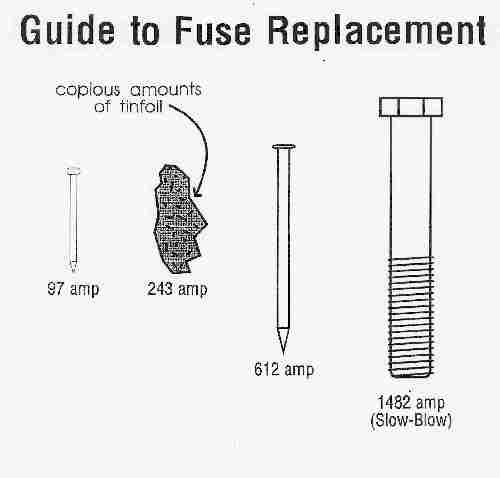
Tut, the solution to your fuse problem:
1994 Lotus Esprit S4 - Work in progress
1980 Porsche 924 Turbo - Funky Interior Spec
2004 Smart Roadster Coupe - Hers
-
robin
- Jedi Master
- Posts: 10546
- Joined: Mon Mar 27, 2006 1:39 pm
Post
by robin » Fri Jul 06, 2012 8:01 am
The one on the right doubles as a crank shaft pulley bolt if required
I is in your loomz nibblin ur wirez
#bemoretut
-
Ferg
- Posts: 3967
- Joined: Fri Sep 04, 2009 11:56 pm
- Location: Auld Reekie
Post
by Ferg » Fri Jul 06, 2012 9:22 am
lol
I think I was just kidding myself I wasn't going to have to buy a replacement. Thanks for the voice of reason...

-
Ferg
- Posts: 3967
- Joined: Fri Sep 04, 2009 11:56 pm
- Location: Auld Reekie
Post
by Ferg » Fri Jul 06, 2012 4:30 pm
Should have wiki'd it in the first place....
Dendritic shorting
When not used regularly, dendrites tend to develop. Dendrites are thin, conductive crystals that may penetrate the separator membrane between electrodes. This leads to internal short circuits and premature failure, long before the 800–1,000 charge/discharge cycle life claimed by most vendors. Sometimes, applying a brief, high-current charging pulse to individual cells can clear these dendrites, but they will typically reform within a few days or even hours. Cells in this state have reached the end of their useful life and should be replaced. Many battery guides, circulating on the Internet and online auctions, promise to restore dead cells using the above principle, but achieve very short-term results at best.
-
thinfourth
- Posts: 3177
- Joined: Tue Mar 15, 2005 12:06 pm
- Location: Playing in the mud near aberdeen
Post
by thinfourth » Fri Jul 06, 2012 6:23 pm
1 Are they NiCads?
2 Have you considered gutting them as a lot of them are standard cell size inside
Landrover 90 = Muddy shed spec
Fiat panda = Couldn't care less spec
Landrover ?? = Muddy shrek spec
Unimog 404S = Very slow silly offroader spec
Kubota F1900 = Snowplough spec
-
Ferg
- Posts: 3967
- Joined: Fri Sep 04, 2009 11:56 pm
- Location: Auld Reekie
Post
by Ferg » Fri Jul 06, 2012 7:05 pm
Yep, definitely Ni-Cd. Hadn't thought about inserting new cells.
Found a similar replacement device inc battery for £49 compared to just a battery for £32. Bizarre.